
A modern ship simply cannot operate without a sophisticated network of piping. Fuel, cooling water, drinking water, steam, gas, lubricating oil, and wastewater—all of these fluids must be transported safely, reliably, and without leaks throughout the entire ship. The skilled workers who design, build, install, and maintain this invisible backbone of a ship are pipefitters and pipe fabricators. In shipbuilding, they are among the most in-demand specialists—throughout a ship’s entire life cycle, from new construction to repairs to refits.
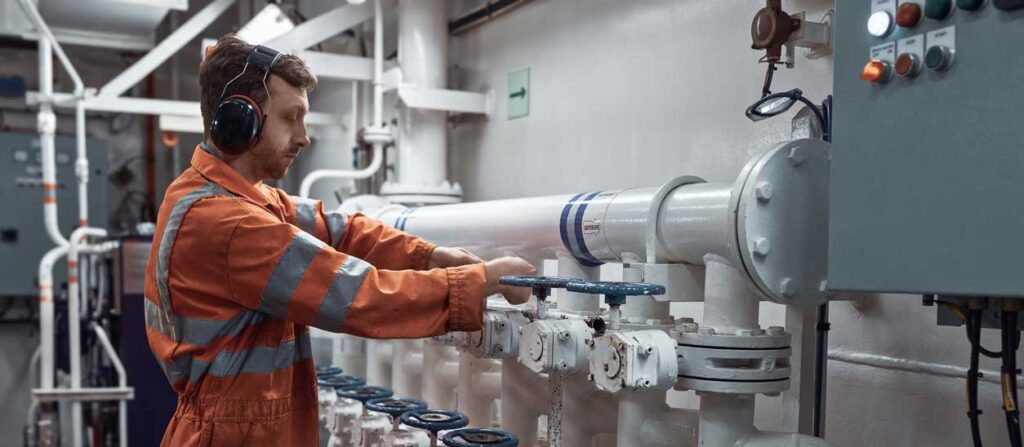
What are the duties and responsibilities of a pipe fitter in shipbuilding?
Pipefitting is a highly specialized trade. In shipbuilding, pipefitters are responsible for in the manufacture, installation, and maintenance of piping systems. In doing so, he works closely with other specialists—such as plant mechanics, energy technicians, and welders—and can thus focus entirely on his core technical tasks.
The main duties of a pipe fitter in shipbuilding include:
- Cutting Pipes to Size Custom-made and in accordance with technical specifications—using state-of-the-art cutting tools and CNC-controlled machines
- Bending and Fitting of pipes, the must be adapted to the available space within the ship—often in very confined spaces and with complex geometries
- Making Connections through screw connections, flanges, and welds—depending on the medium, pressure, and temperature of the piping system
- Testing for Leaks and Load-Bearing Capacity of the fully assembled systems through pressure tests and visual inspections in accordance with class rules
- Compliance with Environmental and Safety Standards, especially when handling flammable liquids and high-pressure lines
With this expertise, pipefitters are involved in nearly every stage of a ship’s construction: in the prefabrication of sections in the shipyard, during assembly directly on board, in repair and maintenance work, and in the retrofitting of existing systems. Hardly any other profession is so evenly distributed across all phases of shipbuilding and ship operation.
The job requires a very high level of artisanal precision. Piping systems must function reliably under varying conditions—including different temperatures, high humidity, and mechanical stresses caused by a ship’s movements at sea. This means that a pipefitter must not only be skilled with his tools but also understand the properties of the various media that flow through the pipes. Fuel, steam, wastewater, gas, and cooling water each have different requirements in terms of leak tightness, material selection, and pressure resistance.
In addition, a pipe fitter in the shipbuilding industry must be familiar with modern welding and testing techniques. This includes welding processes for piping (TIG and orbital welding) as well as non-destructive testing methods for finished joints. Especially when it comes to high-pressure pipelines and systems for flammable media, thorough testing is not an option—it is a requirement.
The Pipe Fitter in Shipbuilding—A Systems Thinker and Coordinator
The pipe fitter is closely related to the pipe welder—but differs from him in one crucial respect: While the pipe fitter focuses on the manual fabrication and assembly of individual pipe sections and connections, the pipe installer takes a broader view of the entire system. They install, connect, and inspect piping for complete circuits—such as energy, water, wastewater, or fuel supply systems.
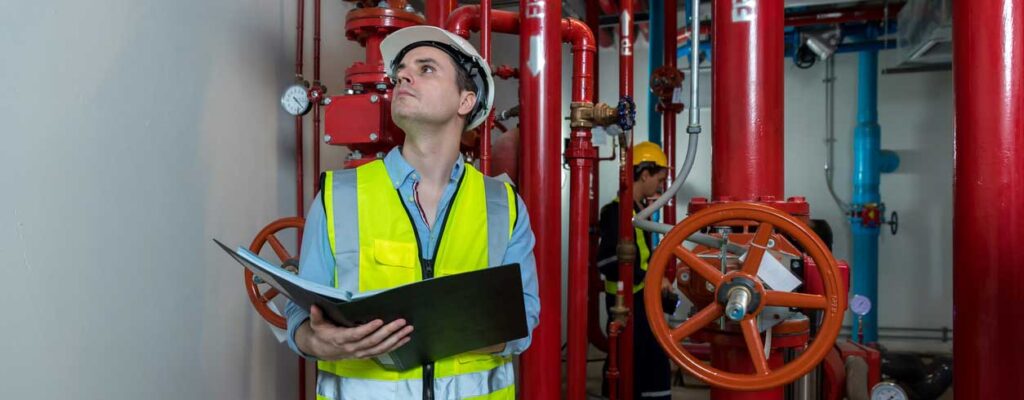
Specifically, this means that pipe fitters install and assemble the individual components—the pipes, valves, flanges, and fasteners. The pipe fitters the installation of all utility lines and pay attention to the following:
- Spatial Coordination: Where do the lines run? What other systems—cable trays, ventilation ducts, structural components—are located in the same area? How can collisions be avoided?
- Flow Directions and Pressure Conditions: Can the fluid become backed up in the pipe or rise unintentionally? Is pressure building up? Are there any areas where air could become trapped?
- Safety distances: Certain substances—such as fuel and exhaust gases—must not be located too close to one another; therefore, the regulations of the classification societies must be followed
- Material Compatibility: Not every pipe material is compatible with every medium; stainless steel, copper, plastic, and composite materials each have their own specific applications depending on the medium and temperature.
Pipefitters are indispensable, especially for highly complex types of ships: tankers with multiple separate cargo circuits, LNG carriers with cryogenic piping systems operating at minus 162 degrees Celsius, research vessels with multiple independent laboratory systems, and offshore supply vessels with redundant safety systems—none of these vessels would function without experienced pipefitters serving as system coordinators.
The pipe fitter works according to technical drawings and isometric plans and implements them in collaboration with technicians and engineers. Today, this work is supported by modern digital tools: 3D models and simulations of piping systems allow the pipe fitter to first plan a complete system virtually, identify collisions, and make changes—before the first screw is tightened in reality. This saves time and money and prevents errors during the subsequent installation.
Differences Between Pipe Fitters and Pipe Installers at a Glance
| Characteristic | Pipe fitter | Pipe Fitter |
|---|---|---|
| Focus | Individual pipe sections, connections, components | Complete piping systems and circuits |
| Primary Activity | Cutting, Bending, Assembly, Welding | Planning, Coordinating, and Laying Entire Pipeline Routes |
| System Level | Component level (pipe, valve, flange) | System Level (Circuit, Supply Line) |
| Digital Tools | Technical Drawings and Isometric Plans | 3D CAD Models and System Simulations |
| Collaboration | Welders, Plant Mechanics, Electricians | Engineers, Technicians, Project Management |
| Typical Ships | All Types of Ships | Tankers, LNG carriers, research and supply vessels |
What is the training process like for pipe fitters and pipe fabricators?
People typically enter the field of pipe fitting or pipe fabrication through a dual training program in a related metalworking or plant engineering trade.. The duration of the apprenticeship depends on the chosen, recognized apprenticeship program and is often three and a half years. The training company may be in the skilled trades or in industry; The main areas of focus are in metal fabrication, plant construction, and piping. The specific training often involves careers such as plant mechanic, construction mechanic, or metalworker—depending on the company and field of work.
What are the requirements for the training program?
To ensure a successful apprenticeship and a smooth start to their career, interested candidates should meet the following personal and professional requirements:
- A good spatial reasoning skills – Pipe connections in three-dimensional space must be planned mentally before they are installed
- Solid Knowledge of materials science and welding technology or a willingness to acquire them
- The ability to, precisely according to technical drawings to work—dimensional deviations in piping construction have direct consequences for installability
- A high Sense of Responsibility – Leaky pipes on a ship are more than just a technical problem; they can pose a serious safety hazard
- The willingness and ability to, working as part of a team – Piping work must always be carried out in coordination with other trades
Health Requirements
In addition, both professionals should meet certain health requirements. The following are particularly important:
- Ability to work at heights and in confined spaces: At shipyards and on board ships, work is performed at various heights and in confined spaces— Dizziness or severe claustrophobia can make it difficult to work in certain environments
- Good physical stamina: Standing for long periods, kneeling, bending over, and carrying heavy pipe sections and tools are all part of the day-to-day work routine
- Resistance to environmental conditions: Noise, humidity, welding fumes, and fluctuating temperatures in shipyards and on board require physical stamina and consistent effort personal protective equipment
Training Content
The training curriculum covers a wide range of topics. Among the most important topics are:
- Reading and Applying Technical Drawings, Isometric Plans, and Piping Diagrams
- Materials Science: Properties and Applications of Stainless Steel, Copper, Plastics, and Composite Materials
- Pipe Processing: Sawing, Bending, Forming, and Fitting
- Welding Techniques for Pipe Joints: TIG welding, orbital welding, and press-fit joints
- Fluid Technology: Behavior of Fluids Under Pressure and Temperature Conditions
- Pressure tests and leak tests in accordance with applicable standards and regulations
- Safety Regulations for Flammable Media and High-Pressure Systems
- Environmental Protection in the Handling of Operating Fluids and Coolants
What are the working conditions and work environment like in pipeline construction at shipyards?
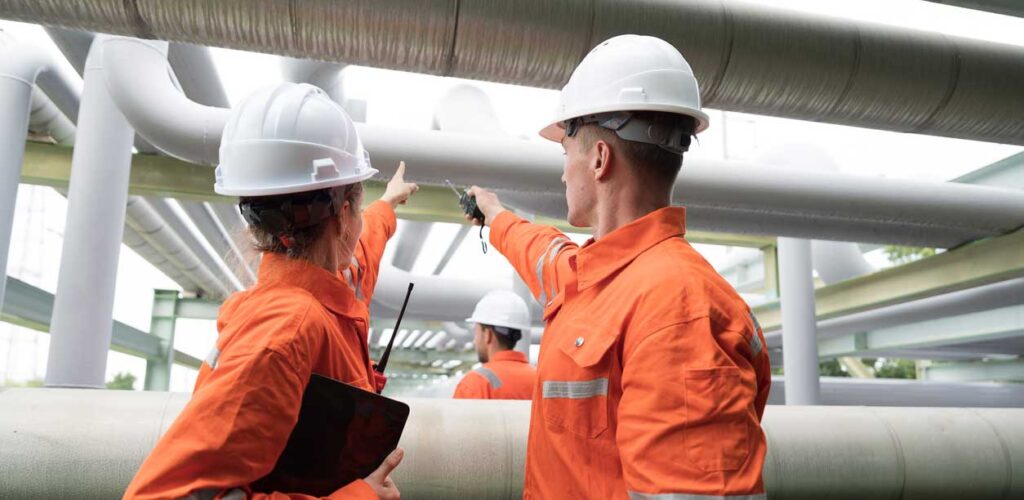
The working conditions of pipe fitters and pipe fabricators in shipbuilding are shaped by the unique characteristics of shipyard operations. Their daily work takes place in large production halls, in dry docks, and directly on board and inside ship hulls as well as in confined spaces. This requires exceptional concentration, a strong safety mindset, and the ability to work with precision even under challenging spatial conditions.
Typical aspects of the work environment:
- Working in Confined Spaces: Double bottoms, tanks, and confined spaces on a ship are part of our daily work environment. The places, in addition to the Ability to work safely in confined spaces, as well as knowledge compliance with the specific safety regulations for working in confined spaces (gas detection, safety personnel, ventilation).
- Physical exertion: Heavy pipe sections, bulky tools, and working in awkward positions—on one’s knees, overhead, or bent over—are common challenges.
- Shift Work: Large shipyards often operate on a shift basis, especially during final assembly in the run-up to the delivery date.
- Changing work locations: When pipe fitters and pipe fabricators are assigned to maintenance or repair work, They can be used worldwide – in ports and shipyards in various countries. This offers variety and international experience, but requires flexibility in terms of time and location.
Despite all the challenges, occupational safety is comprehensively regulated at German shipyards. Personal protective equipment is required, safety training sessions are held regularly, and strict safety protocols are in place, especially when working in confined spaces or with flammable materials.
Which professional Perspectives and Career Opportunities offer itself Pipe Fitters and Pipe fitters?
Pipe fitters and pipe fabricators in the shipbuilding industry are in high demand and in demand not only at German shipyards. Their qualifications are applicable in a wide range of industries, all of which rely on stable piping systems:
- Shipyards: New construction, repair, conversion, and modernization of merchant ships, specialty vessels, and naval vessels
- Offshore Industry: Installation and Maintenance of Piping Systems on on drilling platforms, as well as on ships and facilities associated with offshore wind farms
- Shipping lines and shipping companies: Onboard Maintenance and Repair Tasks
- Plant Engineering and Power Plants: Industrial piping systems in chemical plants, power plants, and process facilities
- Technical Service Providers: International service assignments, which are compensated differently depending on the duration of the assignment, qualifications, and allowances
Opportunities for Advancement and Continuing Education
With sufficient professional experience, pipe fitters and pipe installers have attractive career advancement opportunities:
- Ascent to the Foreman, Shift Supervisor, or Workshop Manager – First-level management responsibilities in shipyard production
- Industrial Foreman (Metal): Qualified for technical, organizational, and managerial roles; with additional certification of training competence, also qualified for roles in training
- State-certified technician, for example, with a focus on mechanical engineering or piping technology: Opens doors in planning, quality assurance, and project management
- Advanced training programs to become a certified welding specialist (IWS), welding technician (IWT), or welding engineer (IWE): For pipe fitters specializing in welding a potential qualification for welding supervision duties
- Degree in Mechanical Engineering or Naval Architecture: For professionals who wish to pursue an academic career
Salary and Earning Potential
The income of pipe fitters and pipe installers in the shipbuilding industry varies depending on professional experience, qualifications, field of work, and region. As a general guide:
- Career Starters: Starting at approximately €2,600–2,900 gross per month, Varies depending on the region, collective bargaining coverage, company, and qualifications
- With professional experience and additional qualifications: well over 3,000 € gross per month, Higher compensation may be available depending on the job assignment and collective bargaining agreement
- Master Craftsmen and Management Positions: up to €5,000 gross and more, Compensation depends on level of responsibility, region, and collective bargaining agreement
- Service technicians working worldwide: Additional compensation components may include overseas allowances and assignment bonuses
Contributing to Sustainability – The Role in the Blue Economy
Pipe fitters and pipe fabricators also make an important contribution to the advancement of maritime technology—particularly in the area of sustainability, known as the “blue economy” of shipbuilding. They work on new piping materials that are lighter, more corrosion-resistant, and more durable. They install efficient heat exchange systems that reduce ships’ energy consumption. And they play a key role in building the piping infrastructure for low-emission propulsion systems—LNG cryogenic systems, methanol lines, and hydrogen supply systems require specific expertise in piping technology that only specialized professionals possess.
This makes pipe fitters and pipefitters key professionals in the transition toward more efficient and, in the long term, lower-emission shipping. Their work lays the technical groundwork for the safe installation, operation, and maintenance of alternative fuel systems.
Frequently Asked Questions About Pipe Fitters and Pipe Fabricators in Shipbuilding
The main difference lies in the approach to the work: The pipe fitter focuses on the manual fabrication and assembly of individual pipe sections, joints, and components—he is the specialist in the precise bending, cutting, and welding of pipes. Pipe fitters work more at the system level: He coordinates the installation of entire pipeline routes, ensuring spatial coordination with other trades, as well as flow directions, safety clearances, and material compatibility throughout the entire piping system.
TIG welding (tungsten inert gas, Process 141) and orbital welding are the primary methods used for pipe joints in shipbuilding. TIG welding is used to create high-quality, leak-tight joints in stainless steel and aluminum pipes, and enables precise, high-quality welds. Orbital welding—a welding process that is usually automated, in which the welding head moves around the pipe – It is used in particular for recurring pipe connections and when there are high requirements for reproducibility and quality. For manual or semi-mechanized TIG welding, welder qualification tests in accordance with the relevant DIN EN ISO 9606 series of standards apply. For mechanized or automated orbital welding, the requirements of DIN EN ISO 14732 generally apply to operators and setup personnel.
Pipefitters are needed on all types of ships, but are in particularly high demand on technically complex vessels: tankers with multiple separate cargo systems, LNG carriers with cryogenic piping systems operating at around minus 162 degrees Celsius, cruise ships with extensive supply and waste disposal systems, as well as research and offshore supply vessels, which feature many independent piping systems on must be installed in a confined space and coordinated with one another.
In particular, Polish, Croatian, and Ukrainian pipefitters with experience in shipbuilding and valid welder certifications in accordance with the applicable DIN-EN-ISO 9606 standard are in demand at German shipyards. Under the principle of the free movement of workers, EU citizens can work in Germany without a visa or work permit. Ukrainian nationals with a residence permit under Section 24 of the Residence Act (AufenthG) or a corresponding provisional residence permit also have access to the German labor market. Adequate knowledge of German or another reliable means of communication is particularly important for safety briefings and day-to-day work.. As a staffing agency, we verify all qualifications and certifications before placing candidates.
Modern shipyards use 3D design software for shipbuilding and piping design, such as AVEVA E3D Design, which is used to control a ship's entire piping system can be planned, visualized, and checked for collisions in three dimensions. For example, isometric drawings as well as material and cutting lists for manufacturing can be derived from the 3D models. Pipe fitters and pipe fabricators who know how to use these tools, can effectively support digital planning and manufacturing processes at modern shipyards..
Entry-level employees typically earn between 2,600 and 2,900 euros gross per month. With increasing experience and additional qualifications—particularly welding certifications for pressure pipelines—salaries well over 3,000 euros are achievable. Master craftsmen in management positions and service technicians working worldwide can earn up to 5,000 euros or more. Service assignments on repair ships or offshore platforms are often supplemented by foreign assignment allowances and assignment bonuses.
Are you looking for experienced pipe fitters or pipe fabricators for your shipyard? We place certified professionals from Poland, Croatia, and Ukraine—with shipbuilding experience, ISO 9606 certification, and sufficient German language skills.