
Without electricity, no ship would function. No control panel would work, no engine would start, no navigation system would operate, and not a single cabin would be lit. Electronics technicians and energy engineers are therefore key specialists in shipbuilding—both at the shipyard and on board. With increasing digitalization, the expansion of sensor technology, hybrid propulsion systems, and rising demands for energy efficiency and environmental protection, their importance has grown significantly in recent years. This article explains the different specializations available, what they actually do, how the training program is structured, and what career prospects are available.
Electricity as the Lifeline of a Ship—Growing Demand and Changing Requirements
Today, ships are more than just floating modes of transportation. They are technologically advanced systems in which dozens of subsystems operate simultaneously: propulsion systems, navigation computers, cargo-handling equipment, climate control systems, fire alarm systems, communication systems, and, increasingly, fully automated control systems for autonomous functions. All of this requires electricity—and more and more of it.
With the ongoing digitalization, the use of sensor technology, the integration of hybrid and electric powertrains, and increased demands for energy efficiency and environmental protection, the requirements for electronics technicians and energy technicians have also undergone fundamental changes. Whereas work used to be based primarily on circuit diagrams and focused on cable connections and mechanical installations, today’s tasks involve complex, networked systems. These range from automation technology and smart energy management to the integration of environmental technology and renewable energy sources. This career therefore offers good future prospects and at the same time is more challenging than ever.
What is an overview of the three fields of study?
The duties and responsibilities of electronics technicians and power systems technicians in the shipbuilding industry vary depending on their specialization. In the shipbuilding industry, two apprenticeship programs in particular—as well as advanced qualifications in energy and environmental technology—are relevant::
- Electronics Technician for Industrial Systems – Focus on electrical systems, machinery, and drive systems
- Electronics Technician for Energy and Building Systems – Focus on vehicle electrical systems, power distribution, and comfort systems
- Energy and Environmental Engineer – Focus on energy efficiency, environmental protection, and sustainability
Together, these three fields form the electrical backbone of a modern shipyard and a modern ship. The more a specialist deepens their expertise through continuing education, the more valuable they become to the industry—and the better their earning potential and career prospects.
What do electronics technicians specializing in industrial engineering do in the shipbuilding industry?
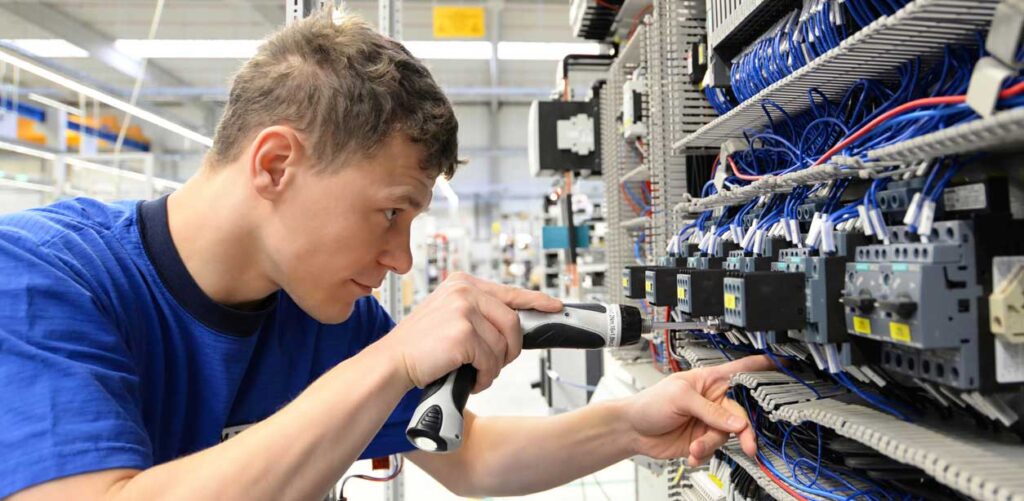
The industrial electronics technician is the quintessential all-rounder among electrical specialists in shipbuilding. He installs, maintains, and repairs electrical systems and equipment – both at the shipyard and on board the ships.
Tasks at the Shipyard
In a shipyard setting, an industrial electronics technician works on a wide variety of equipment and systems. He installs switchgear and control panels, as well as generators and drive systems, so that they operate reliably and safely. It ensures that welding robots, assembly lines, inspection systems, and crane systems—in other words, a shipyard’s entire production infrastructure—are supplied with a stable and reliable source of electrical power. Without it, shipyard production literally comes to a standstill.
Duties on board
Electronics technicians specializing in industrial engineering work on board ships key components of the electrical infrastructure: power distribution via the ship’s electrical system, the cabling for all systems, and ensuring emergency power supply—because on a ship at sea, a power outage is not just an inconvenience, but a safety issue. Their scope of work ranges from the navigation system to the control of the ship’s engines and the lighting system.
As the share of electric and hybrid powertrains continues to rise, the importance of these skilled workers is increasing significantly once again. Qualified professionals install and inspect high-voltage systems., connect battery storage systems to the ship's electrical system and precisely coordinate the power electronics with the other propulsion components. This is especially true for hybrid and fully electric systems Knowledge of high-voltage and power electronics is in particularly high demand.
What are the responsibilities of electronics technicians specializing in energy and building technology in the shipbuilding industry?
In shipbuilding, the electronics technician for energy and building systems is responsible for the ship’s electrical systems and power distribution in the ship’s living and work areas. They wire cabins, lounges, kitchens, and technical systems—and ensure that passengers and crew have a reliable supply of electrical power at all times.
Specifically, his area of responsibility includes:
- Installation and Commissioning of Lighting systems – from simple task lighting to complex LED lighting systems with smart controls
- Installation and Connection of Air Conditioning and Heating Systems including the electrical control system
- Installation of Water Treatment Plants, which are also electrically powered and controlled
- Integration of digital Smart Cabin systems On modern cruise ships and yachts—guests control the lighting, temperature, and entertainment via touchscreens
- Cabling and Commissioning of Communication Systems, fire alarm systems, and emergency call systems
Yachts and cruise ships represent a particularly significant area of application for this field. Here, passenger comfort and safety play a central role—and both depend directly on a reliable, redundantly designed electrical power supply. Electronics technicians specializing in energy and building technology rely on their in-depth knowledge of electrical engineering and a high degree of technical precision: Even just one incorrectly installed cable connector In a high-current circuit, this can pose a fire hazard.
What do energy and environmental engineers do in shipbuilding?
The energy and environmental engineer combines two key fields into a single career path: traditional electrical engineering and environmental management. This qualification is accepted everywhere particularly in demand in areas where sustainability, energy efficiency, and environmental protection are key priorities, and these areas are becoming increasingly important in modern shipbuilding.
His responsibilities are diverse and forward-looking:
- Analysis and Optimization of Energy Flows: Where is energy being lost? Where can consumption be reduced? How can the available energy be distributed more efficiently?
- Design and Installation of Renewable Energy Systems: Solar panels on deck, systems for heat recovery from exhaust gases and wastewater, wind turbines on sail ferries
- Integration of alternative propulsion systems: LNG engines, fuel cell systems, and electric propulsion systems must be integrated into the ship’s existing power grid and coordinated with one another—a challenging systems engineering task
- Support for Compliance with Environmental Regulations: Depending on the position, the energy and environmental engineer helps monitor relevant emission and energy efficiency targets
- Further Development of System Concepts: In collaboration with engineers, he develops concepts for the use of new technologies—such as the integration of battery storage systems into hybrid ferries
With the growing importance of green shipbuilding, this profession has taken center stage. Energy and environmental engineers serve as the link between the technical traditions of shipbuilding and the requirements of sustainable shipping in the future.
What does the training program for electronics technicians and energy technicians in shipbuilding entail?
Both industrial electronics technicians and energy and building services electronics technicians are trained through the dual training system. The standard duration of training for both of the electronics technician occupations mentioned is three and a half years. Under certain conditions, a reduction is possible. The training company may be a shipyard, a shipbuilding supplier, or an electrical engineering firm with a maritime focus.
Training Content
The training program covers all the fundamentals necessary for a future career in shipbuilding:
- Fundamentals of Electronics and Electrical Engineering: Ohm's Law, alternating current technology, circuit design—the foundation of all electrical engineering work
- Installation, Commissioning, and Maintenance of Electrical Systems: From individual components to complex switchgear systems
- Measurements, Tests, and Protective Measures: Electrical tests in accordance with VDE and DIN standards, insulation measurements, functional tests after commissioning
- Control and Regulation Technology: Programmable Logic Controllers (PLCs), Control Loops, Sensor Integration
- Electric Drive Systems: Fundamentals of Electric Drives and Their Control—From Generator Operation to Electric Motors in Hybrid Drive Systems
- Safety Regulations: Workplace Safety for High-Voltage Work, VDE Regulations, Classification Rules for Ships (DNV, Lloyd's, Bureau Veritas)
Training Path to Become an Energy and Environmental Technician
One possible path into the field of energy and environmental technology involves completing relevant technical vocational training followed by further education. Alternatively, relevant college programs are also an option.. Afterward, various continuing education paths are available:
- State-Certified Technician – Specializing in Energy and Environmental Technology: A two-year technical college program that provides training in energy management, environmental law, thermodynamics, plant design, and renewable energy systems
- Degree in Energy Engineering, Environmental Engineering, or Marine Engineering: Each university decides whether professional qualifications or work experience can be credited toward a degree program
- Continuing education courses in energy management, environmental law, and renewable energy systems: Certificate courses designed to provide qualifications for specific requirements in green shipbuilding

What opportunities for specialization are available in one's professional life?
Electronics technicians working in shipbuilding can specialize in certain areas that are in particularly high demand over the course of their careers:
- Switchgear and Control Systems: Integration of complex switchgear and control systems for a ship's main systems; particularly in demand at large shipyards with a high degree of automation
- Power Distribution Systems: Design and Installation of Medium- and High-Voltage Distribution Systems on Large Commercial Ships and Cruise Ships
- High-Voltage Technology for Electric Drives: Installation and commissioning of high-voltage battery systems and power electronics for hybrid and electric powertrains—a rapidly growing field of specialization
- Marine Automation and Sensors: Programming and integration of automation systems, IoT sensors, and data acquisition systems for digital vessel monitoring
- Marine Environmental Technology: Exhaust gas cleaning systems (scrubbers), ballast water treatment systems, and emission monitoring systems
What are the career prospects and salary like?
Electronics technicians and energy technicians in shipbuilding are among the most in-demand skilled workers in the industry. Digitalization, new propulsion technologies, and the expansion of offshore wind energy point to continued strong demand. Career opportunities span many industries:
| Field of Study / Level of Qualification | Typical position | Scope of Application | Salary (gross/month) |
|---|---|---|---|
| Electronics Technician in Industrial Engineering (Entry-Level) | Electrician at a Shipyard / On a Ship | Installation, Maintenance, Commissioning | 2,700–3,200 € |
| Electronics Technician for Energy and Building Systems | Onboard Electrician, Systems Electrician | Cruises, Yachts, Ferries | 2,800–3,400 € |
| Experienced Electronics Technician + Specialization | High-Voltage / Automation Specialist | Hybrid Drives, Control Systems | 3,500–4,500 € |
| State-Certified Technician (Energy/Environment) | Energy Systems Technician, Quality Assurance | Planning, Review, Project Support | 3,800–5,000 € |
| Energy & Environmental Engineer | Systems Engineer, Green Tech Project Manager | Green Shipbuilding, Smart Ships | starting at €5,000 |
Electronics Technicians from Eastern Europe in the German Shipbuilding Industry
There is a shortage of qualified electricians and electronics technicians for the shipbuilding industry in the German labor market—competition for these skilled workers is intense. Eastern European countries such as Poland, Croatia, and Ukraine provide high-quality training for electronics technicians and electrical engineers; their training programs and certifications are compatible with German standards.
As a staffing agency with over 35 years of experience, we place qualified electricians and electronics technicians from Eastern Europe with shipyards and maritime companies—through temporary staffing, service contracts, or direct employment. All candidates are screened for qualifications and German language proficiency before placement.
Frequently Asked Questions About Electronics Technicians and Energy Technicians in Shipbuilding
The electronics technician for industrial engineering focuses on electrical systems, machinery, and drive systems—installing switchgear, generators, control panels, and drive systems. Electronics technicians specializing in energy and building technology, on the other hand, are responsible for the electrical infrastructure in the ship’s living and working areas—onboard power systems, cabin lighting, air conditioning systems, water treatment, and communication systems. Both professions overlap in their basic training but differ significantly in their focus and typical areas of application.
Ships are becoming increasingly complex from a technological standpoint: more electronics, more automation, hybrid and electric propulsion systems, extensive sensor technology, and digital control systems. At the same time, the supply of qualified electricians on the German labor market is declining. Electricians with expertise in shipbuilding are therefore doubly rare—and in high demand as a result. Added to this is the fact that the offshore wind industry is drawing from the same pool of skilled workers, which further intensifies competition for qualified electricians.
Electricians who work on hybrid marine propulsion systems need expertise in high-voltage technology (systems operating at 1,000 V DC or 1,500 V AC or higher), power electronics (frequency converters, inverters, DC/DC converters), battery technology (lithium-ion systems, cell management, cooling), and system integration (coordination of the battery, diesel generator, and electric motor via an energy management system). These qualifications are also rare in the general job market—electricians who possess them are paid above average.
An energy and environmental engineer analyzes a ship’s energy consumption and identifies opportunities for savings. He plans and installs renewable energy systems—such as solar panels on the upper deck or heat exchangers that use waste heat from the engines to heat water. They integrate environmental technology such as exhaust gas cleaning systems (scrubbers) and ballast water treatment systems. And they ensure that the ship complies with all relevant IMO regulations on emissions and energy efficiency—tasks that have become significantly more important with the green transition in the shipping industry.
EU citizens from Poland, Croatia, and Lithuania can work in Germany without a work permit; their professional qualifications may be recognized under the EU Professional Qualifications Recognition Act. Language skills (German at least at the B1 level) are essential for safety training and day-to-day work. As a staffing agency, we conduct all qualification and language tests prior to placement and assist with the documentation required for recognition.
Entry-level employees typically earn between 2,700 and 3,200 euros gross per month. With professional experience and specializations—such as in high-voltage technology, marine automation, or energy management systems—salaries rise to between 3,500 and 4,500 euros. State-certified technicians earn between 3,800 and 5,000 euros; engineers specializing in energy and environmental technology start at 4,500 euros. Service technicians who work on assignments worldwide often receive additional overseas allowances and can earn well over 5,000 euros.
Are you looking for qualified electricians or electronics technicians for your shipyard? We place certified professionals from Eastern Europe—with the right certifications, sufficient German language skills, and experience in the maritime sector.